
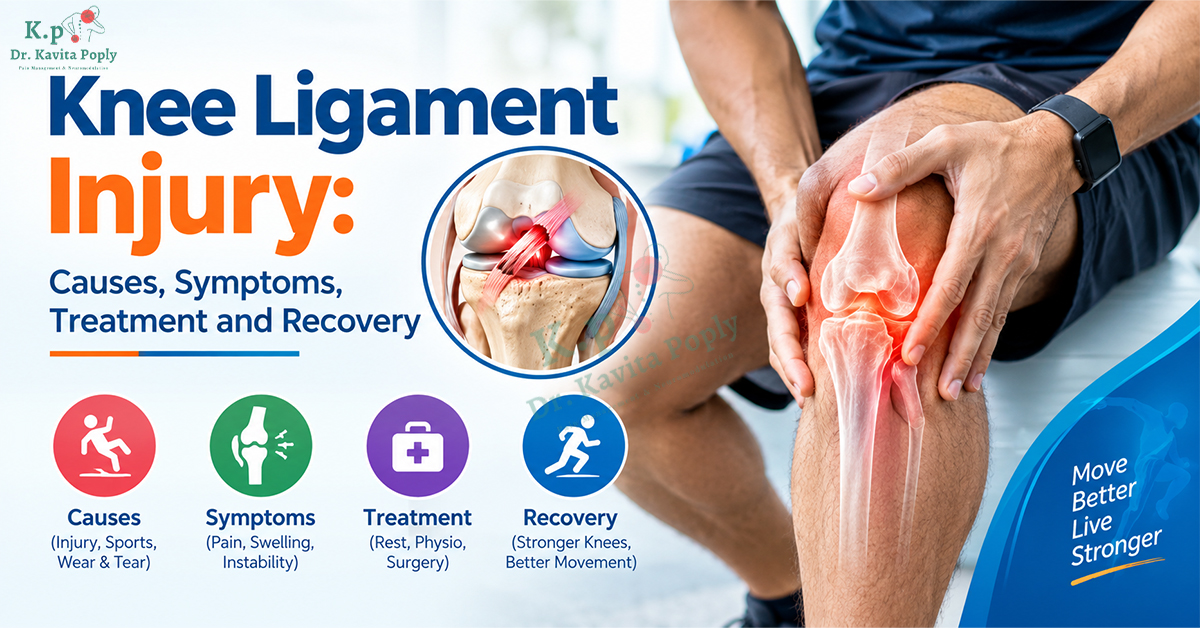
Knee ligament injuries are common among active adults, athletes, and people who experience sudden falls, twists or blows. Ligaments are basically strong bands of connective tissue which connect bones and help in keeping the knee stable during movement. An injury can range from a mild twist to a complete ligament tear.
The treatment and recovery time depends on the severity of the ligament injury. While some injuries may improve with rest and physiotherapy, others especially ACL injury, may require surgery.
What Is a Knee Ligament?
There are four ligaments in the knee which provide stability, these are:
- Anterior cruciate ligament (ACL): this ligament helps in preventing the shinbone from moving too far and also controls the rotational stability.
- Posterior cruciate ligament (PCL): It helps in preventing excessive backward movement of the shinbone.
- Medial collateral ligament (MCL): It provides stability to the inner side of the knee.
- Lateral collateral ligament (LCL): It provides stability to the outer side of the knee.
These ligaments work together with muscles, cartilage, tendons, and bones to make knee functional.
What Is a Knee Ligament Injury?
A knee ligament injury is an injury which occurs when one or more ligaments are hurt making them stretch more than their normal range or are torn. Generally, doctors classify ligament injury in three grades:
- Grade 1: In this injury, the ligament is mildly stretched but remains intact.
- Grade 2: In this grade, the ligament is partially torn which can make the knee unstable.
- Grade 3: In this ligament injury, the ligament is completely torn which leads to instability.
A ligament injury can happen on its own or in addition to other injuries like cartilage damage, bone injury and meniscus tear.
What Causes Knee Ligament Injuries?
A knee ligament injury may occur due to sudden change in the movement. Some of the common knee ligament injury causes are as follows:
- Sudden change in movement
- Landing incorrectly after jumping
- Twisting knee when the foot position remains same
- A sudden blow, or twist of the knee
- Injury while playing sports
- Fall or an accident
ACL injury is most common during sports which involves movement like jumping, pivoting and sudden change in direction.
Common Symptoms of Knee Ligament Injury
Knee ligament injury symptoms may vary depending on the ligament and severity of the injury. Some common signs include swelling, popping sensation, pain, tenderness, bruising, reduction in movement, bruising, difficulty in walking, running and doing normal activities, and a feeling of instability.
Types of Knee Ligament Injuries
There are majorly four types of knee ligament injury, these are as follows:
ACL Injury
An ACL tear may occur when a person suddenly changes direction, twists the knee or lands in an incorrect position. In this injury, partial or complete tear can happen.
PCL Injury
A PCL injury may happen when a strong force pushes the shinbone backward during an accident or a fall.
MCL Injury
An MCL injury may happen as a result of a force applied to the outside of the knee leading to its inward movement. This injury is common in contact sports.
LCL Injury
This injury involves ligaments on the outside of the knee and is likely to occur when a force pushes the knee outward.
How Is a Knee Ligament Injury Diagnosed?
Knee ligament injury diagnosis starts with physical examination and checking the medical history of the patient. The doctor may ask questions related to the injury and perform stability tests to check the ligaments. In certain cases, imaging might be necessary like X-ray, MRI, and Ultrasound.
X-ray: It helps in identifying the fracture, and bone abnormalities.
MRI: This provides images of the soft tissues and help in identifying the meniscus, cartilage and other injuries.
Ultrasound: It may be used to assess certain soft-tissue structures.
You Can Also Read: Cold Plunge: Benefits, Risks, and How to Get Started
Knee Ligament Injury Treatment Options
Knee ligament injury treatment depends on the patient’s age, overall health, severity of injury and its grade.
1. Rest and Activity Modification
In case of mild injury, doctor may advise rest and reduction in activities that can increase the pain. In certain cases, temporary use of crutches may be recommended.
2. Ice and Compression
Cold therapy helps in reducing the pain, and swelling during the early stage of injury. Patient can use a compression bandage or brace as suggested by the doctor.
3. Medication
Doctors may recommend pain-relieving or anti-inflammatory medicines where needed.
4. Knee Braces
Patients may be suggested braces which provide support and stability while the injured knee heals.
5. Physiotherapy
Physiotherapy plays an important role in rehabilitation of the ligament injury. It reduces stiffness, strengthens quadriceps and hamstring muscles, and restores functional and knee movement.
When Is Surgery Needed for a Knee Ligament Injury?
Knee ligament injury doesn’t always need surgery. There are numerous MCL injuries which can be managed without an operation. However, in some cases, knee ligament surgery is the only solution, these are:
- When a ligament is completely torn leading to instability
- An injury including multiple ligaments
- A ligament is completely torn and causes significant instability
- Knee structure has also been damaged
- There is a need for hight stability
- Non-surgical treatment isn’t helpful
Recovery After a Knee Ligament Injury
Knee ligament injury recovery time depends on the intensity of injury, age and overall health of the patient. While a mild sprain may improve in several weeks, a complete tear can take months to heal. The recovery process majorly comprises of the following 5 phases.
- Initial phase: This phase includes controlled pain and swelling while the knee remains protected.
- Mobility phase: During this phase, gentle exercises are done to restore the knee’s ability to move.
- Strengthening phase: Exercises are done to strengthen the muscles which support the knee.
- Functional phase: In this phase, the patient is helped with balancing, coordination and movement patterns.
- Return-to-activity phase: The regular activities slowly start happening with the professional guidance.
You Can Also Read: Actinic Keratosis: Symptoms, Causes, Treatment & Prevention
Exercises for Knee Ligament Injury Recovery
The exercises for knee ligament injury are selected depending on the patient’s condition and strength. There are common rehabilitation exercises which are practiced by the patient, these are as follows.
- Quadriceps contractions: This exercise is about tightening the thigh muscle while keeping the leg straight.
- Straight-leg raises: It includes lifting the leg while maintaining control.
- Heel slides: In this, the patient is required to bend and straighten the knee for improving mobility.
- Bridges: This exercise strengthens the gluteal and posterior-chain muscles.
- Hamstring and quadriceps strengthening: This exercise helps in increasing the resistance.
- Balance exercises: These exercises help in improving the control and stability around the knee area.
- Step-ups and controlled squats: This exercise is introduced during rehabilitation when the patient is able to do them.
How to Prevent Knee Ligament Injuries
The knee ligament injuries can be prevented by practicing the following measures.
- Always warm up before the exercise or sport
- Practice jumping and correct landing techniques
- Strengthen the quadriceps, glutes, hamstrings, and core
- Exercise to improve balance and coordination
- Increase the training intensity slowly
- Use appropriate shoes during the activity
- Follow sport-specific conditioning programs
- Avoid intense activity until previous injury is recovered
When Should You See a Doctor?
You should immediately see a doctor if you have been experiencing severe pain, visible deformity, swelling, difficulty in performing regular activities, and listening to a popping sound. In case of serious injury, urgent medical attention is needed to be given.
Conclusion
Knee ligament injury ranges from mild sprains, partial tear to complete tears. There are different ligament injuries which can happen due to sudden twisting, incorrect landing, or falling directly on the knee. It is essential that you immediately consult an experienced healthcare expert who can diagnose and provide the appropriate treatment.
Dr. Kavita Poply is an expert in the field of pain medicine and neuromodulation. She has been providing exceptional care to her patients and helping them get back to their normal lives. If you want to consult her regarding knee ligament pain, book an appointment now.
FAQs
Q.1 What are the common symptoms of a knee ligament injury?
Ans. The common symptoms of a knee ligament injury are swelling, tenderness, difficulty in bearing weight, tenderness, knee pain, instability, and reduced movement. In some cases, a popping sensation may be experienced when the injury occurs.
Q.2 Can a knee ligament injury heal without surgery?
Ans. Yes, some ligament injuries heal and become stable without surgery. This happens in case of partial tears and isolated MCL injury.
Q.3 How long does a knee ligament injury take to recover?
Ans. Recovery duration of a knee ligament injury depends on the severity of the injury. Mild sprains may take weeks to improve but complete tears can take up to several months.
Q.4 When is surgery needed for a knee ligament injury?
Ans. In case of complete ligament tear causing persistent instability, multiple ligament injuries, related damage to knee structures or when the non-surgical treatment doesn’t help, surgery may be suggested.
Q.5 Can physiotherapy help with a knee ligament injury?
Ans. Yes. Physiotherapy helps with restoring range of motion, balance, strength, and coordination. A well-structured program helps in preparing the knee for a gradual return to performing normal activities like before.